

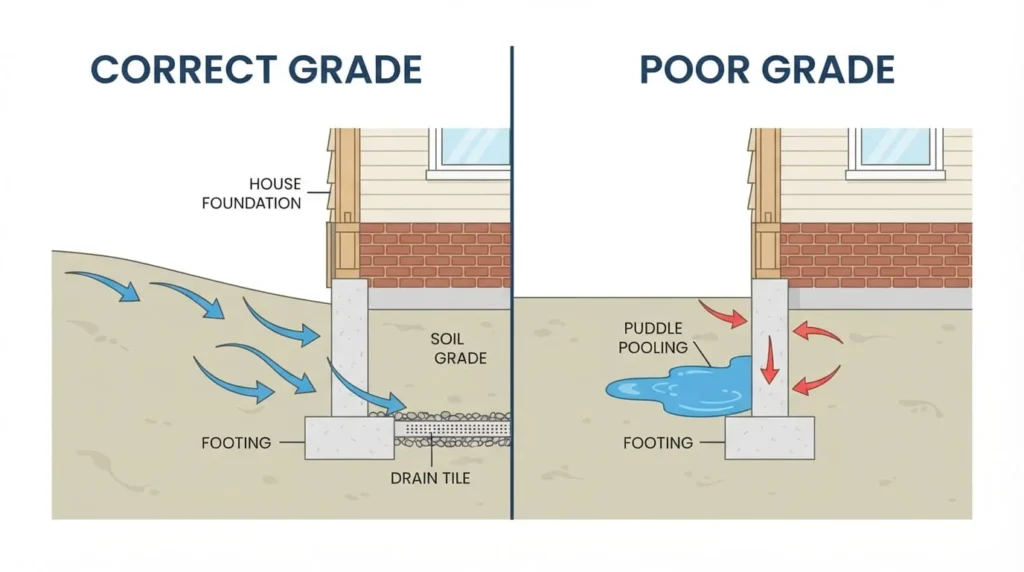
Yard grading is reshaping the slope of your land so water flows away from your house instead of pooling against the foundation. The standard target is a drop of at least one inch per foot for the first ten feet away from the house, which follows the International Residential Code.
Why Yard Grading Matters
Water that sits against a foundation doesn’t stay put. It works into hairline cracks, and over a few wet seasons those cracks widen into real structural problems. A poorly graded yard can also send water into a basement, turn parts of the lawn into standing puddles that breed mosquitoes, and wash away topsoil during heavy rain.
Grading isn’t only about the foundation, either. A yard with unpredictable dips and bumps mows unevenly, drowns grass roots in the low spots, and dries out the high ones. Fixing the slope evens out both problems at once.
How Much Slope Does A Yard Need
Codes and landscapers don’t all agree on one exact number, but they land in the same range. The International Residential Code, which most U.S. cities follow, calls for a minimum drop of one inch per foot for at least the first ten feet from the foundation. Some guides frame the same idea as a percentage: a 5% grade, which works out to roughly a six-inch drop over ten feet.
Yardcare.com sets a wider acceptable band for a yard overall, from about 2% at the low end up to 25% before erosion becomes a real risk. Anything under 2% risks water sitting still. Anything over 15% starts to make mowing genuinely unsafe on top of the erosion problem.
Further from the house, the slope can ease off. A common rule is about one inch per foot near the foundation, tapering to something closer to three inches per ten feet farther out into the yard.
How To Measure Your Yard’s Current Slope
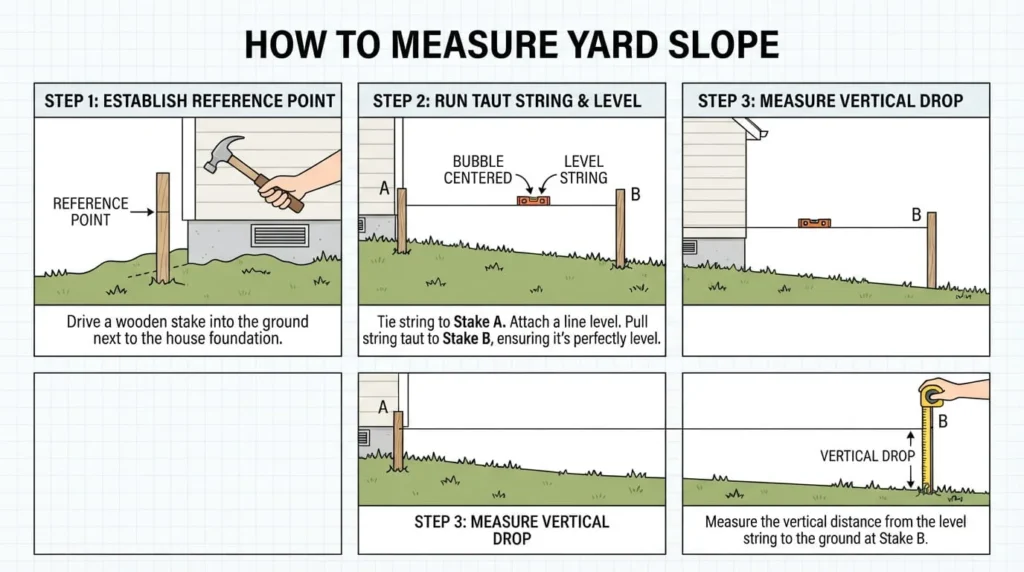
You don’t need surveying equipment to get a usable measurement. Two wooden stakes, about ten feet of string, a line level, and a tape measure will get you there.
Drive one stake into the ground right next to the foundation and a second stake about eight to ten feet away, out in the yard. Tie the string to the foundation stake at ground level, pull it taut, hang the line level on it, and adjust until the string reads level. Tie the other end to the second stake at that same height.
Now measure the distance from the string down to the ground at the far stake. If that gap is six inches over a ten-foot run, you’re sitting right at the 5% target. If the gap is only an inch or two, the ground barely slopes at all, and water has nowhere to go but sideways, toward the house.
Tools For A Diy Yard Grading Project
For small, localized fixes, a flat shovel, a landscaping rake, and a wheelbarrow cover most of the work. You’re mainly moving soil from the high spots to the low ones.
For anything beyond patch repairs, Decks.com notes a skid steer typically rents for $350 to $550 a day, which is worth it once you’re moving more than a few cubic yards of soil. A laser level, useful for larger or uneven yards, often rents for under $100 a day and gives a much more reliable reading than eyeballing it.
Before any of that, call 811. Utility companies will mark buried gas, water, and electric lines for free, and digging into one of those is a mistake you only make once.
Step By Step Process For Grading A Yard
Start by walking the yard after a hard rain and marking every spot where water sits or visibly runs toward the house. Those marks are your map for the rest of the project.
Cut the grass short so you can see the soil surface, then remove sod from the areas you’re going to regrade, setting healthy pieces aside if you want to replant them later. Loosen the exposed subsoil so it’s workable, then move dirt from your high points into the low points, checking your progress against the stake-and-string measurement as you go.
Once the new slope reads correctly, spread topsoil back over the area to a depth of around four inches, till it into the subsoil underneath so it doesn’t wash away as a loose layer, rake it smooth, and water it to help it settle. Seeding right away is worth doing immediately, since new roots are what actually hold the regraded soil in place.
When Regrading Isn’t Enough On Its Own
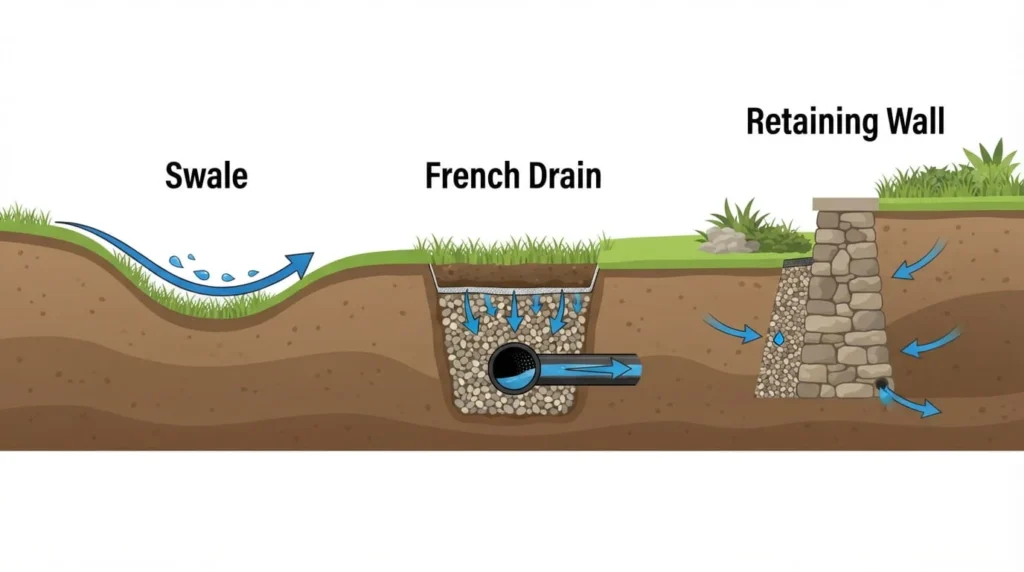
Grading fixes slope, but it doesn’t fix every drainage problem by itself. If water keeps collecting even after the slope is correct, a shallow ditch called a swale can carry it around a low area. For persistent water that grading alone can’t move fast enough, a French drain, a buried perforated pipe surrounded by gravel, gives water an underground path away from the house.
Steep lots present the opposite problem. If your yard’s existing slope is already too aggressive, a retaining wall breaks it into manageable tiers instead of one long, erosion-prone incline.
How Much Does Yard Grading Cost
Home Briefings estimates basic DIY grading, tools and materials like topsoil and grass seed included, at $200 to $500 for a small project. Hiring a professional landscaper or excavation contractor runs $1,000 to $5,000, with the total depending on yard size, soil conditions, and how much equipment time the job needs.
Ware Landscaping notes that in many jurisdictions, changing the grade by more than 24 inches or disturbing more than 2,500 square feet triggers a permit requirement, so it’s worth a call to your local building department before starting a large-scale project.
When To Call A Professional Instead Of Doing It Yourself
Small corrections around the foundation, a soggy patch near a downspout, a shallow dip that collects puddles, are reasonable DIY jobs. Slopes over 30%, areas larger than 1,000 square feet, or drainage problems that involve a neighboring property are a different situation. At that point the grading affects more than your own yard, and a mistake can send water toward someone else’s foundation instead of your own.
Frequently Asked Searched Questions
1. What is the minimum slope for yard drainage?
The International Residential Code calls for at least a one-inch drop per foot for the first ten feet away from the foundation. That works out to roughly a 5% to 10% grade in that zone closest to the house.
2. How much does it cost to regrade a yard?
Small DIY corrections run $200 to $500 for tools and materials. Professional regrading typically costs $1,000 to $5,000, depending on the size of the yard and how much equipment time the job requires.
3. Can I grade my yard myself?
Yes, for localized fixes near the foundation or small low spots. Larger areas, steep slopes over 30%, or drainage issues that cross into a neighbor’s property usually call for a professional with grading equipment.
4. Do I need a permit to regrade my yard?
It depends on your municipality. Many areas require a permit if you’re changing the grade by more than 24 inches or disturbing more than 2,500 square feet, so check with your local building department first.
5. What’s the difference between grading and leveling a yard?
Leveling flattens bumps and fills small holes to create an even surface. Grading shapes the slope of the land so water moves in a specific direction, usually away from the house.